
Gardner Directory Collections by Year
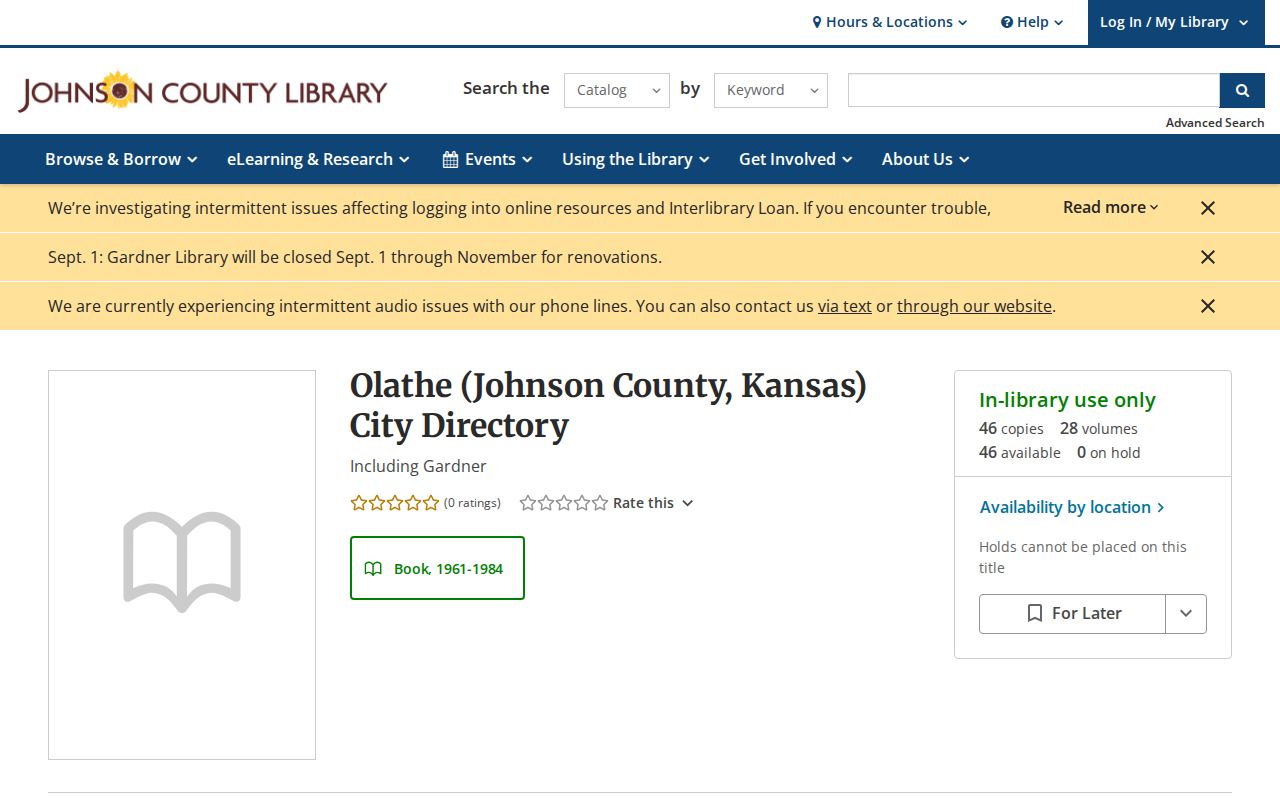
The firmest local catalog evidence is the R.L. Polk & Co. Olathe and Johnson County city directory including Gardner. The Johnson County Library record verifies a 1961 through 1984 run and marks it for in-library use. Other sources broaden the search, but they do not prove a complete Gardner-only run. Exact reverse-directory years also remain an open library question.
| Collection | Verified years | Where held | Access |
|---|---|---|---|
| R.L. Polk Olathe/Johnson County directory including Gardner | 1961-1984 | Johnson County Library | In-library use |
| Kansas town and city directories | Through 1963 indicated statewide | Kansas Historical Society and library resources | Confirm the exact Gardner title and year |
| Reverse or criss-cross volumes | Not verified | Ask the Genealogy Desk | Search by publisher, title, and year |
| Johnson County obituary cards | 1977-2000 | Central Resource Library Genealogy Desk | Citation index; request a copy |
| Gardner Gazette | 1899-1942 indicated | JoCoHistory and library routes | Check exact issue availability |
| Kansas and territorial census | 1855-1925 series | Kansas Historical Society | Household comparison by census year |
The absence of a cataloged year is not proof that no directory exists. It means the claim must remain unverified until staff locate a title, edition, or film record.
Gardner's Verified Polk Directory Run
The Johnson County Library catalog record names R.L. Polk & Co. as publisher and describes an Olathe and Johnson County city directory including Gardner for 1961 through 1984. That wording matters. These are not proven Gardner-only books, and the date range should not be stretched to claim every year or a later edition without checking the physical record.
Review the catalog source before requesting a volume.
Write down the edition, page, and call information before leaving the library. A later citation should lead another researcher back to the same book.
Gardner Directories at the Desk
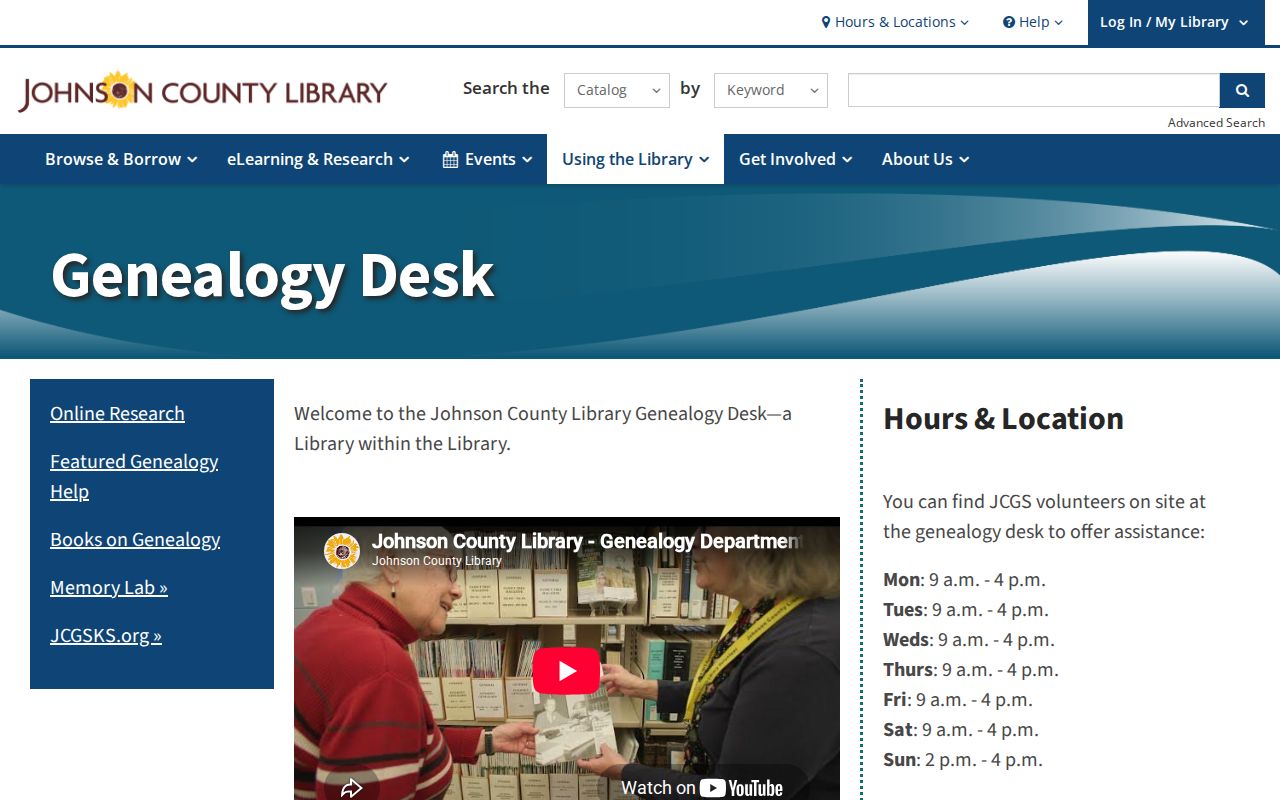
The Johnson County Library Genealogy Desk sits at the Central Resource Library, 9875 W. 87th Street in Overland Park. The library and Johnson County Genealogical Society partnership dates to 1972. Posted volunteer times are Monday through Saturday, 9 a.m. to 4 p.m., and Sunday, 2 to 4 p.m. Confirm the schedule before travel.
The desk offers research computers, genealogy books, microfilm, microfiche, maps dating to 1860, local histories, yearbooks, directories, the Old Book Cabinet, obituary cards, and a Memory Lab. Its noncirculating genealogy holdings number about 7,000 items. Ask staff to search Polk, R.L. Polk, suburban, telephone, reverse, criss-cross, and city-directory titles by year.
See the library's Genealogy Desk access page before visiting.
The Gardner branch is closer to the city, but its current page reports a renovation closure from September 1 through November 2026. Check status first.
Read a Gardner Directory Entry
No scanned Gardner page was safely available for a named sample. The right method is therefore an inventory, not a made-up transcription. Copy each item as printed and photograph or transcribe the abbreviation key before expanding any symbol.
| Edition and page | The exact dated source and place within the volume |
|---|---|
| Name | Surname, given name, initials, and spelling as printed |
| Household notation | Spouse, widow, rooming, or other publisher wording |
| Address | House number, suffix, street spelling, and city |
| Owner mark | The printed symbol, without assuming what it means before checking the key |
| Occupation or affiliation | Only the text shown in that edition |
| Cross-reference | A business listing or separate address section, if present |
- Criss-cross directory
- An address-first section organized by street and house number instead of surname.
- Householder index
- A listing centered on named household heads or principal entries, not every occupant.
- Abbreviation key
- The publisher's own guide to shortened words and symbols in that edition.
A directory address is an edition-date clue. It is not automatically the same as a deed situs, tax mailing address, or voter address.
Trace Gardner Households by Edition
Build a year-by-year worksheet for the Gardner city directory trail. One row should hold one edition, even when no entry appears. That preserves gaps instead of smoothing them into a false continuous residence.
- Start with a known name and address within the verified 1961-1984 Polk span. Copy the entry and abbreviation key exactly.
- Check the prior and next available editions. Track initials, spouse notes, widow wording, business lines, and street changes.
- Search the address independently if an address-first section exists. Another household member may be the main entry.
- Pair the result with an available federal or Kansas census close to the same date. Keep each source's date and purpose separate.
- Use an obituary citation, newspaper item, cemetery record, deed, or probate file to test why the listing stops.
A disappearance can mean a move, death, omission, name change, or a boundary and coverage change. It should not be labeled until another source supports the reason.
Pair Gardner Directories with Census
Kansas territorial censuses cover 1855 through 1859. State censuses then run from 1865 through 1925 at ten-year intervals ending in five. Federal census images are public through 1950 under the 72-year release rule. These dated household lists can bridge years before the verified Polk run and test a family relationship near a directory date.
| Period | Gardner research source | What the date means |
|---|---|---|
| 1855-1859 | Kansas territorial census | Early county and settlement snapshot |
| 1865-1925 | Kansas state census years ending in 5 | Household at a census moment |
| Through 1950 | Released federal census | Household on the enumeration date |
| 1961-1984 | Gardner-inclusive Polk editions | Publisher's dated directory snapshot |
A census, directory, and deed can all name the same person while answering different questions. Agreement strengthens a hypothesis, but it does not make the sources interchangeable.
Gardner Names in Local Newspapers
JoCoHistory identifies several Gardner papers: Young Kansan, Kansan, Gardner Graphic, Kansas True Flag or Gardner Flag, Gardner Weekly Message, and Gardner Gazette. The Gardner Gazette has the longest identified run, 1899 through 1942, though exact issue availability still requires a viewer or microfilm check.
Search more than a surname. Use a street, business, church, probate notice, wedding, death notice, school event, or legal notice. Save the newspaper title, issue date, page, and image or citation. Short-lived titles can explain why a search in the Gazette alone misses an event.
JoCoHistory's Gardner collection is the online entry point. Library databases and microfilm provide fallback access when a scan is absent.
Gardner Obituary and Cemetery Clues
The library's Johnson County obituary card catalog covers 1977 through 2000. It often supplies a citation rather than the image, so request the underlying copy through the library or genealogical society. A death notice may explain a widow notation, household move, relative, or final address found in a Gardner city directory.
Gardner Township Cemetery adds an online burial search, maps, and history. Early cemetery records were lost in a fire, leaving some lot ownership and burials unknown. A missing database result must be checked against newspapers, deeds, obituaries, the 1866 cemetery plat, County Archives, and KSHS.
Records gap. The cemetery fire is a documented loss, so absence from the online burial search does not prove absence from Gardner.
Gardner's Digital Memory Collections
JoCoHistory holds more than 40,000 photographs, newspapers, maps, and oral histories across its collections. A 2025 library collaboration highlighted photographs, oral histories, obituaries, newspapers, and yearbooks. The Gardner Historical Museum adds local memories, artifacts, and genealogy leads.
One Gardner oral history describes a local research hunt that began in 1952 and returned to Topeka newspapers in 1961, then drew on KU, KSHS, library sources, old deeds, and the town-lot layout. It is a useful model: memory starts the question, while documents test it.
Oral history should be cited by collection title and date. Confirm names and places against a map, deed, newspaper, census, or directory edition before joining them to a family line.
Gardner Directory Record Timeline
Gardner was settled in 1857, and the county's early trail begins in territorial and early-state records rather than a modern city database. The media then shifts from census and county books to newspapers, directories, microfilm, and digital collections.
| Year or span | Research milestone |
|---|---|
| 1855-1859 | Territorial census period and early Johnson County context |
| 1857 | Gardner settlement era and start of county deed series |
| 1899-1942 | Gardner Gazette run identified in JoCoHistory research |
| 1961-1984 | Verified Gardner-inclusive R.L. Polk catalog span |
| 1977-2000 | Johnson County obituary card catalog |
| 2025 | Library and JoCoHistory collaboration expands digital discovery |
No official source reviewed established Gardner's first directory or the last printed year outside the Polk catalog span. Preserve that uncertainty.
Gardner City Directories for Genealogy
A city directory trail is strongest when every entry is treated as one dated clue. Preserve initials, spouse and widow notes, street spellings, owner marks, and gaps. Then test them with a census, obituary, cemetery entry, newspaper notice, probate index, or deed. The Kansas Historical Society ancestry resources add state censuses, naturalization abstracts, vital abstracts, and directories through 1963.
Johnson County Archives and KSHS also hold deed, court, probate, marriage, tax, and naturalization series. Finding aids may describe records without placing the images online. Carry the full name, date range, Gardner address, edition citation, and known relative into an archive request.
Modern address-keyed research belongs in the Gardner street records workflow. Historical city directories answer a different question: where a publisher placed a named person or household in one edition.